The society running on a 35‑year‑old database
A golf society founded in 1904, with three decades of its records inside a FileMaker database written around 1990 by a man now in his mid‑eighties, and no plan for the day he stops.
Every golf society has a secretary, and most of them have a system. A spreadsheet only they understand. A folder of results going back years. Something that works, right up until the morning it doesn't.
This one has one of the better ones. It holds every member, every meeting, every handicap and every result going back decades, and it works out the standings on its own. It has done its job faithfully for thirty-five years.
It is a FileMaker database, written around 1990. The man who built it is in his mid-eighties.
We couldn't have designed a more difficult system, but it's grown up over what, a hundred and twenty odd years.The society secretary
What "complicated" actually meant
Most software for clubs assumes your competition looks like everyone else's. This one doesn't, and that is rather the point of it. Over a century the rules have accumulated, and every one of them means something to the members who play under them.
- An Order of Merit counted on each member's best three finishes across the eight meetings that count, from a calendar that also contains several that don't.
- A second table, run over a different set of meetings on a rolling window straddling two seasons, deciding who plays the match against the French press.
- Winners hand a shot back to the field. Division one winner and runner-up lose one, division two winner loses two, runner-up one. The shot follows you for the rest of that season and all of the next, then falls away.
- Two divisions every meeting, the field split down the middle by handicap, with no fixed line.
- Half a shot a year for every year over sixty-five, at one meeting a season.
- One meeting played as a strict medal off the full handicap, when the rest are Stableford off ninety-five per cent.
- Thirty-six hole days where the afternoon is a different course, playing to a different difficulty, in pairs, off a combined handicap.
None of that is unreasonable. It is simply that no off-the-shelf product will ever do it, and no sensible software company wants to. Which is precisely why it ended up in a bespoke database in 1990, and precisely why it was still there in 2026.
The part nobody wants to say out loud
The database runs on old copies of FileMaker, because new ones must be bought outright rather than updated. It was built for a Mac and coaxed onto Windows about ten years ago, where it is, in the secretary's word, clunky.
Its author was one of the great cricket photographers of his generation. He is not a software company. There is no support line.
We've been worried about a succession plan for quite some time.The society secretary
That is the real problem, and it is not a golf problem. It is every old institution that got a good system early from someone clever who is now getting on. Lose him, and decades of records sit locked inside software nobody else can open.
What we did
We rebuilt it. Not a version of it, not something close enough. The actual thing, rule for rule, off the back of one long conversation in which the secretary explained how his society really works.
Every rule above is in it. The best-three Order of Merit. The rolling second table. The penalties, decaying on their own schedule. The divisions splitting themselves. The half-shot for the over-sixty-fives. The medal that plays off a different percentage to everything else. The thirty-six hole days across two courses.
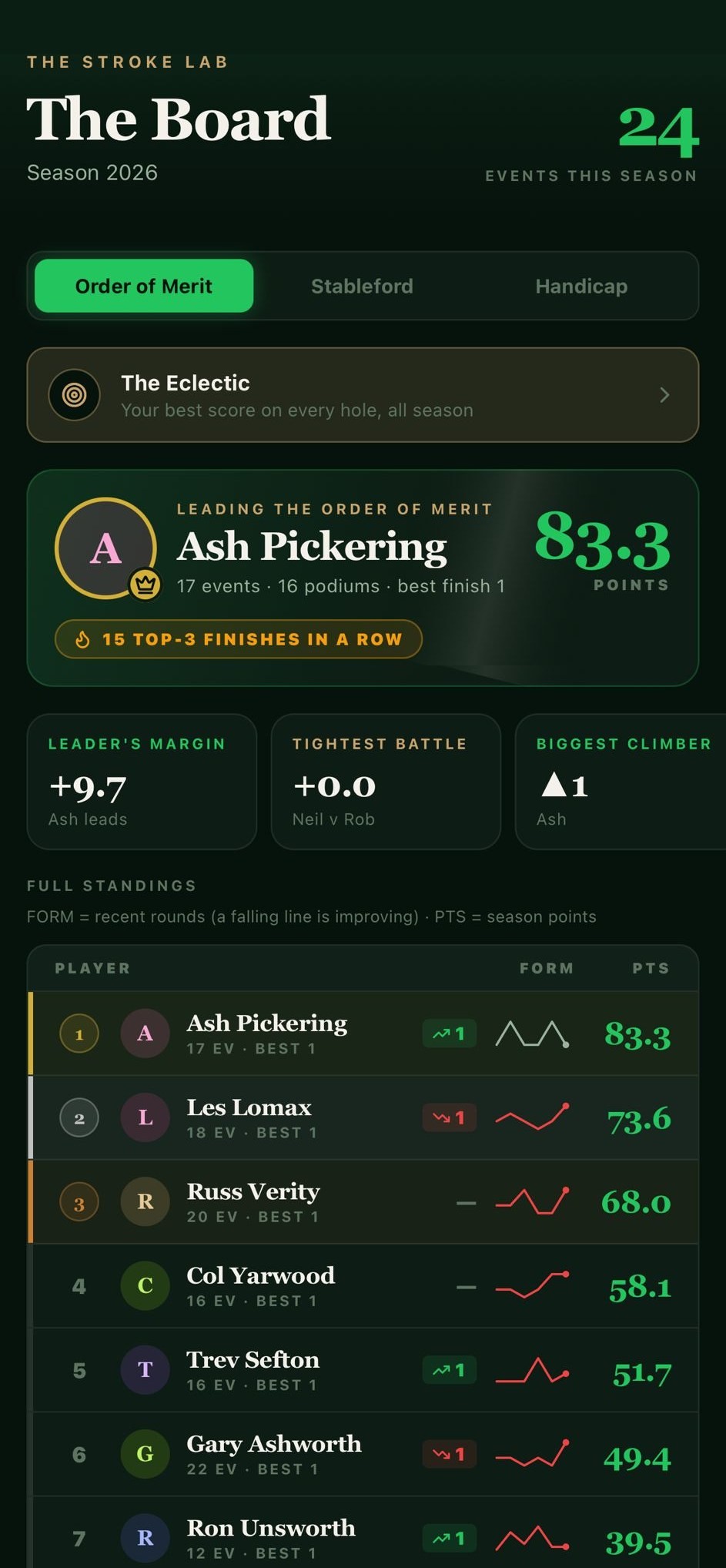
The scoring runs off the real cards of the real courses they play, hole by hole, par and stroke index. The maths matches the cards to the shot. Members enter their own scores on their phones if they want to, or hand a card in as they always have and the secretary types it. Both work. Nothing scores until the secretary starts the round, so nothing appears that shouldn't.
He also sent five emails per meeting, batched by surname, because his list lived in Gmail and Gmail will not send to two hundred people at once. That is one button now.
What it costs to leave it alone
There is a market price for this work, and it is worth knowing before you decide to do nothing.
Rebuilding a bespoke society database
| A London FileMaker consultancy, new build | £10,000 to £20,000 |
| The same firm's smallest billable job, one bug fix | from £920 |
| Their support retainer | from £460/mo |
| Moving your existing records across | they don't |
That last line is the one that matters. Every membership platform on the market says the same thing in its onboarding: type your members in. Your history is your problem.
That is the job nobody wants. It is the one we take.
Where it stands now
The society has its own secretary's portal on the web, and its members have the app. The records moved. The rules came with them. The next secretary inherits something that can actually be handed over, rather than a database and a phone number for a man in his eighties.
And when a rule changes next season, which it will, there is someone to ring.
Does your society have one of these?
An old spreadsheet. An older database. One person who understands it. If your rules are too odd for ordinary software and too important to lose, that is the conversation we like having.
Talk to us about a buildThis is a real client and a real build. The quotations are the secretary's own, from our first call, used with permission. Consultancy rates are published figures from a UK software consultancy.